Digital Product Passports, engineered for ESPR Compliance.

ClarosDPP supports organizations in developing Digital Product Passport solutions by consolidating product, material, sustainability, and regulatory data into a harmonized structure, and delivering it through a passport framework aligned with the Ecodesign for Sustainable Products Regulation (ESPR) and other applicable EU compliance requirements.

What a DPP must contain

🪪 01
Product identity Unique identifiers, model details, manufacturer info, and market placement records.
⚗️ 02
Material & substance data Component breakdown, material origin, hazardous substance declarations, and SCIP alignment.
🌿 03
Environmental evidence Carbon footprint, recycled content ratios, durability metrics, and lifecycle impact data.
🔧 04
Use, repair & end-of-life Repair instructions, spare part availability, disassembly guidance, and recycling routes.
📋 05
Compliance documentation Declarations of conformity, test reports, certifications, and applicable regulation references.
🔒 06
Governance & history Access control rules, data provenance, version history, and audit trail records.

What is a Digital Product Passport?

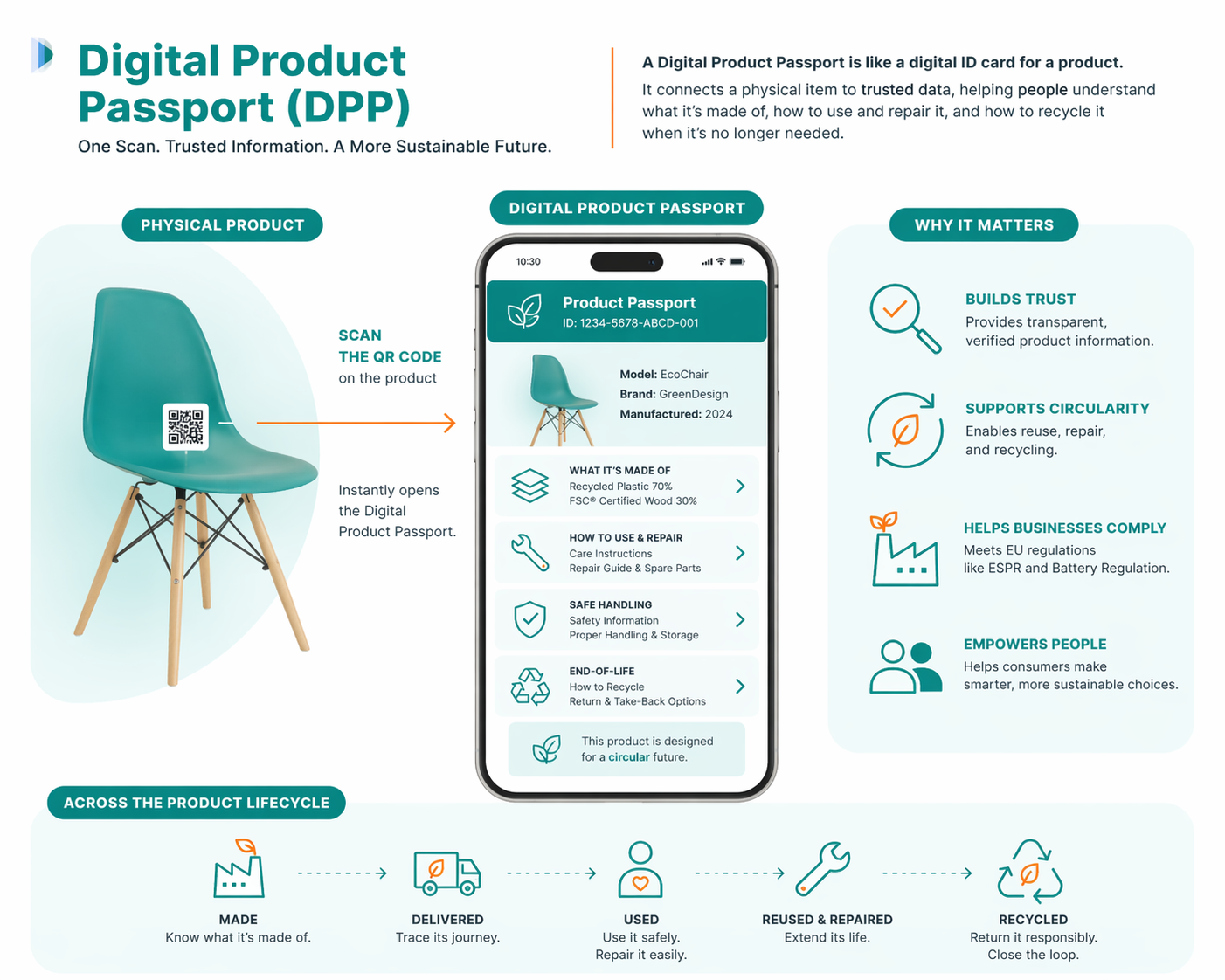
In simple terms, a Digital Product Passport (DPP) acts as a digital identity for a product. It connects the physical item to reliable digital information, typically via a QR code or similar data carrier, allowing users to understand what the product is made of, how to use and repair it, how to handle it safely, and how it can be recovered or recycled at the end of its life. It also creates a consistent way to share verified product data across the entire value chain, from manufacturers to regulators and end users. By improving transparency and traceability, a DPP helps companies meet regulatory requirements while enabling more sustainable and circular product practices.
Why DPP Was Made Mandatory

The EU introduced Digital Product Passports because circular economy goals cannot be effectively achieved with fragmented and inconsistent product data. Policymakers require reliable, standardized information to track products across their entire lifecycle-from supply chains and usage to repair and end-of-life handling. By making DPPs mandatory, the EU aims to improve transparency, strengthen regulatory compliance, and enable better decision-making for businesses, authorities, and consumers alike. This ensures products are easier to reuse, repair, and recycle, ultimately reducing waste and environmental impact.

To establish a unified product data framework

ESPR (EU) 2024/1781

ESPR establishes the legal basis for DPPs and standardises durability, reparability, and circularity data in a structured, machine-readable format across the EU market and its regulatory systems.

To enable data-driven market surveillance

EU market surveillance framework

DPPs give authorities direct access to verified product data, improving enforcement efficiency, strengthening oversight, and reducing the circulation of non-compliant products across the internal market.

To improve traceability across value chains

REACH, RoHS, waste, due diligence data

DPPs keep substances, restricted materials, sourcing, waste, and due diligence data consistently recorded and accessible across the product lifecycle for compliance checks and reporting needs.

To enable repair, reuse, and recycling

Circular economy objective

DPPs make post-market product information accessible so repairers, refurbishers, and recyclers can handle products correctly, extend product lifetimes, and improve material recovery outcomes over time.

To improve industrial data interoperability

Interoperability objective under ESPR

DPPs introduce a harmonised data structure that improves interoperability between manufacturers, suppliers, platforms, and regulators across European value chains and connected digital systems.

To improve waste traceability and compliance

Waste Framework Directive (2008/98/EC)

DPPs support waste policy by providing structured data on material composition, hazardous substances, and disassembly, improving classification accuracy and recycling efficiency in practice.

Turning Compliance into Competitive Advantage

A well-designed Digital Product Passport should extend beyond regulatory compliance. Its real value emerges when it becomes a strategic data infrastructure that helps organisations understand product behaviour in the market, trace lifecycle movement, and see how materials circulate through reuse and recovery systems. When combined with analytics, the passport evolves from a reporting obligation into a source of commercial intelligence.

1
Improve product design and engineering feedback loops

Lifecycle and service data can feed R&D and engineering teams directly, improving durability, modularity, repairability, and cost efficiency in future product development.

2
Reduce compliance and supply chain risk exposure

A structured and continuously updated passport reduces uncertainty across ESPR, REACH, RoHS, and related obligations by keeping compliance evidence accessible and defensible.

3
Increase asset value through lifecycle traceability

Verified histories covering materials, usage, repairs, and end-of-life pathways strengthen resale, leasing, refurbishment, and recovery economics by reducing uncertainty.

4
Unify fragmented product and sustainability data

Consolidating ERP systems, supplier declarations, LCA studies, material data, and service records into one passport layer creates the foundation for downstream value creation.

5
Enable full lifecycle visibility of products and materials

End-to-end tracking from raw material sourcing through production, use, and recovery improves transparency over product and material flows across the lifecycle.

6
Generate actionable internal intelligence through analytics

Structured passport data enables lifecycle modelling, performance tracking, and anomaly detection that turn compliance information into practical decision-support intelligence.

7
Strengthen circular strategy and operational efficiency

Reliable lifecycle data helps organisations optimise sourcing, repair, remanufacturing, and recovery planning while improving overall resource efficiency.

8
Strengthen customer and downstream partner transparency

Standardised product information improves trust and coordination across customers, procurement teams, recyclers, and service partners throughout the value chain.

The passport acts as a continuous thread across the product lifecycle, linking inputs, manufacturing, in-use performance, and end-of-life recovery into one connected record.

This is essential for compliance, but equally valuable for strategy, as it improves visibility into material flows, product performance, service behaviour, and opportunities for reuse and secondary value creation.

Material flow Scan analytics Recovery insight Lifecycle dashboards Telematics-ready patterns

Want to see how this works in the real platform? Explore the product page for the full operating view.

View Product →